Ms. B (pseudonym), a patient from Kazakhstan, underwent kidney cancer surgery locally. Unfortunately, during routine follow-up, imaging studies revealed multiple nodules in her liver. Further enhanced CT scans showed a centripetal filling lesion in the right lobe of the liver, confirming a space-occupying lesion. Clinically, the possibility of liver metastasis from kidney cancer was highly suspected, and she was advised to undergo long-term, regular follow-up. To seek a more precise treatment plan, Harbor Health assisted Ms. B in first consulting with the Department of Urology at Peking University People's Hospital . Simultaneously, Harbor Health organized an expert team to consider her postoperative pathological classification, liver lesion burden, and immune function status, recommending NK cell immunotherapy as adjuvant therapy to precisely eliminate minimal residual cancer cells, consolidate the surgical efficacy, and inhibit metastasis progression. Subsequently, Harbor Health assisted Ms. B in further evaluating the feasibility of standardized NK cell therapy intervention at the Cell Therapy Center of the General Hospital of the Chinese People's Liberation Army (301 Hospital) .
Case Profile
- Condition
- Kidney cancer after surgery with suspected liver lesion risk
- Patient
- Ms. B
- Age
- Not disclosed
- Hospital
- Peking University People's Hospital and 301 Hospital Cell Therapy Center
- Nationality
- Kazakhstan
Case Overview
Ms. B (pseudonym), a patient from Kazakhstan, underwent kidney cancer surgery locally. Unfortunately, during routine follow-up, imaging studies revealed multiple nodules in her liver. Further enhanced CT scans showed a centripetal filling lesion in the right lobe of the liver, confirming a space-occupying lesion. Clinically, the possibility of liver metastasis from kidney cancer was highly suspected, and she was advised to undergo long-term, regular follow-up. To seek a more precise treatment plan, Harbor Health assisted Ms. B in first consulting with the Department of Urology at Peking University People's Hospital . Simultaneously, Harbor Health organized an expert team to consider her postoperative pathological classification, liver lesion burden, and immune function status, recommending NK cell immunotherapy as adjuvant therapy to precisely eliminate minimal residual cancer cells, consolidate the surgical efficacy, and inhibit metastasis progression. Subsequently, Harbor Health assisted Ms. B in further evaluating the feasibility of standardized NK cell therapy intervention at the Cell Therapy Center of the General Hospital of the Chinese People's Liberation Army (301 Hospital) .
Cause & Challenge
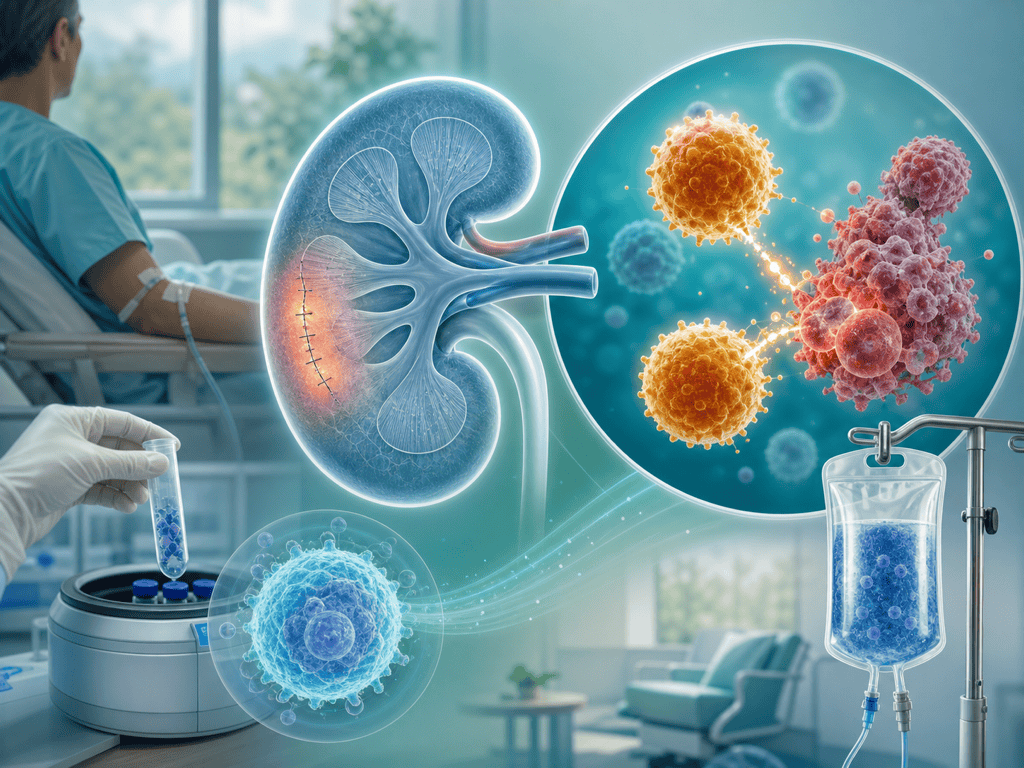
What is NK cell immunotherapy? NK cells (natural killer cells) are the core effector cells of the human body's innate immune system. Originating from hematopoietic stem cells in the bone marrow, they are large granular lymphocytes. Without antigen pre-sensitization or antigen-presenting cells (APCs) mediation, they can initiate a natural killer effect by recognizing MHC class I molecules and tumor-associated antigens (TAAs) on the surface of tumor cells, precisely lysing tumor cells. At the same time, they secrete cytokines such as IFN-γ and TNF-α, regulating the activation of dendritic cells (DCs) and T lymphocytes, constructing a dual anti-cancer defense line of "innate immunity + acquired immunity," and are hailed as the human body's "first firewall" against cancer. The core mechanism of NK cell immunotherapy involves extracting peripheral blood mononuclear cells (PBMCs) from patients using in vitro isolation and purification techniques. These PBMCs are then activated and targeted for expansion in vitro using cytokines such as IL-2, IL-15, and IL-18, while simultaneously enhancing their cytotoxic activity (e.g., upregulation of activation receptors like CD16 and NKG2D). These enhanced NK cells are then reinfused intravenously into the patient, achieving precise elimination of minimal residual disease (MRD). Unlike the indiscriminate killing of cells by traditional radiotherapy and chemotherapy, NK cell therapy offers advantages such as high specificity, high safety, and low toxicity. It effectively avoids cytokine release syndrome (CRS) and prevents damage to normal hematopoietic cells and tissue cells, making it particularly suitable for cancer patients with weakened immune function after surgery who cannot tolerate high-intensity radiotherapy and chemotherapy. Related clinical studies have confirmed that NK cells activated by IL-2 combined with IL-15 exhibit 3-5 times increased cytotoxic activity against pathological types such as clear cell renal cell carcinoma and papillary renal carcinoma, effectively exerting a specific anti-tumor effect.
Why China
Harbor Health connected the patient with appropriate Chinese medical resources, coordinated expert review, hospital access, interpretation, and treatment planning based on the case needs.
Treatment & Benefits
NK cell therapy planned to support immune control of residual cancer risk.
Full Story
What is NK cell immunotherapy? NK cells (natural killer cells) are the core effector cells of the human body's innate immune system. Originating from hematopoietic stem cells in the bone marrow, they are large granular lymphocytes. Without antigen pre-sensitization or antigen-presenting cells (APCs) mediation, they can initiate a natural killer effect by recognizing MHC class I molecules and tumor-associated antigens (TAAs) on the surface of tumor cells, precisely lysing tumor cells. At the same time, they secrete cytokines such as IFN-γ and TNF-α, regulating the activation of dendritic cells (DCs) and T lymphocytes, constructing a dual anti-cancer defense line of "innate immunity + acquired immunity," and are hailed as the human body's "first firewall" against cancer.
The core mechanism of NK cell immunotherapy involves extracting peripheral blood mononuclear cells (PBMCs) from patients using in vitro isolation and purification techniques. These PBMCs are then activated and targeted for expansion in vitro using cytokines such as IL-2, IL-15, and IL-18, while simultaneously enhancing their cytotoxic activity (e.g., upregulation of activation receptors like CD16 and NKG2D). These enhanced NK cells are then reinfused intravenously into the patient, achieving precise elimination of minimal residual disease (MRD). Unlike the indiscriminate killing of cells by traditional radiotherapy and chemotherapy, NK cell therapy offers advantages such as high specificity, high safety, and low toxicity. It effectively avoids cytokine release syndrome (CRS) and prevents damage to normal hematopoietic cells and tissue cells, making it particularly suitable for cancer patients with weakened immune function after surgery who cannot tolerate high-intensity radiotherapy and chemotherapy. Related clinical studies have confirmed that NK cells activated by IL-2 combined with IL-15 exhibit 3-5 times increased cytotoxic activity against pathological types such as clear cell renal cell carcinoma and papillary renal carcinoma, effectively exerting a specific anti-tumor effect.
In the standardized cancer treatment system, traditional standard treatments such as surgery, radiotherapy, chemotherapy, and targeted therapy are fundamental, but all have significant limitations. NK cell immunotherapy can synergistically enhance traditional standard treatments, precisely addressing their shortcomings. Specifically, the core effects of NK cell immunotherapy are reflected in three dimensions: First, it consolidates the efficacy of surgery, precisely eliminating postoperative circulating tumor cells (CTCs) and minimal residual disease (MRD), reducing the tumor recurrence rate. This is especially effective for patients like Ms. B who show potential signs of metastasis after surgery, inhibiting lesion progression and blocking metastatic pathways. Second, it reshapes the body's immune microenvironment, repairing damage to the immune system caused by radiotherapy, chemotherapy, and targeted therapy, increasing the proportion of CD4+ T cells and CD8+ T cells, enhancing the patient's own anti-cancer immune response, and reducing the occurrence of complications such as infection and fatigue. Third, it delays tumor progression. For patients with advanced-stage cancer and distant metastasis, the cytotoxic effects of NK cells can control lesion size, prolong progression-free survival (PFS) and overall survival (OS), and improve the patient's quality of life.
It is important to emphasize that NK cell immunotherapy is not a "panacea" for cancer treatment. Its application is subject to specific clinical indications and is primarily suitable for the following groups: First, patients who have undergone surgery for solid tumors (such as kidney cancer, liver cancer, lung cancer, and breast cancer), especially those with minimal residual disease and a high risk of recurrence; second, cancer patients who have developed resistance or disease progression after radiotherapy, chemotherapy, or targeted therapy, who can alleviate their condition and overcome treatment bottlenecks through NK cell immunotherapy; third, patients with advanced-stage cancer who cannot tolerate radiotherapy, chemotherapy, or targeted therapy, who can use it as a mild palliative treatment to control tumor progression and improve their quality of life; and finally, high-risk individuals with a family history of cancer, weakened immune function (such as decreased CD4+ T cell count), or long-term exposure to carcinogens, can undergo NK cell immunotherapy for immune intervention after evaluation by a professional physician to enhance the body's anti-cancer ability and reduce the risk of cancer.
Currently, Ms. B's liver lesions are stabilizing, and her serum tumor marker levels (such as CA199 and CEA) are gradually returning to normal, laying a solid foundation for long-term recovery. Ms. B's treatment journey not only provides a valuable reference for the recovery of patients after kidney cancer surgery, but also highlights the enormous potential of NK cell immunotherapy in the field of tumor immunotherapy.
Note: This international medical case was compiled from patient or family interviews. Important details and images have been protected to preserve privacy and data security.
For more information about medical travel to China or remote consultations with Chinese specialists, please contact Harbor Health.