Recently, Mr. P (pseudonym), a 66-year-old patient from Russia, recovered well after a series of standardized treatments and is now successfully undergoing adjuvant chemotherapy after surgery. Looking back on his treatment journey, it was the precise early screening via capsule endoscopy that allowed for the early detection of malignant lesions in his stomach, winning valuable time for subsequent surgical treatment and once again highlighting the important significance of early gastrointestinal screening for the prevention and treatment of digestive tumors.
Case Profile
- Condition
- Gastric cancer detected through capsule endoscopy
- Patient
- Mr. P
- Age
- 66
- Hospital
- Peking University Cancer Hospital
- Nationality
- Russia
Case Overview
Recently, Mr. P (pseudonym), a 66-year-old patient from Russia, recovered well after a series of standardized treatments and is now successfully undergoing adjuvant chemotherapy after surgery. Looking back on his treatment journey, it was the precise early screening via capsule endoscopy that allowed for the early detection of malignant lesions in his stomach, winning valuable time for subsequent surgical treatment and once again highlighting the important significance of early gastrointestinal screening for the prevention and treatment of digestive tumors.
Cause & Challenge
It is reported that Mr. P, 66 years old, had no obvious or specific gastrointestinal symptoms recently. During a routine health screening, he opted for a capsule endoscopy, which revealed a space-occupying lesion in his stomach, indicating an abnormality. To further clarify the diagnosis, the relevant medical institution arranged a pathological consultation, which ultimately confirmed a malignant gastric cancer. Upon learning of the diagnosis, Mr. P and his family were extremely anxious and urgently needed professional medical support. At a critical moment, Harbor Health swiftly intervened, leveraging its advantages in cross-border medical assistance to coordinate with top domestic oncology resources, helping Mr. P to seek treatment at the Gastrointestinal Oncology Center of Peking University Cancer Hospital. As a benchmark institution in the field of gastrointestinal oncology treatment in China, the center boasts a top-tier team of experts, a comprehensive treatment system, and extensive clinical experience, particularly in standardized gastric cancer surgery and the development of comprehensive treatment plans. The expert team conducted a comprehensive assessment of Mr. P's condition. A personalized surgical plan was then developed, and the surgery was successfully performed, completely removing the gastric lesion and effectively halting disease progression. Currently, Mr. P is recovering well post-surgery and is receiving adjuvant chemotherapy as planned.
Why China
Harbor Health connected the patient with appropriate Chinese medical resources, coordinated expert review, hospital access, interpretation, and treatment planning based on the case needs.
Treatment & Benefits
Early screening enabled timely standardized cancer treatment.
Full Story
It is reported that Mr. P, 66 years old, had no obvious or specific gastrointestinal symptoms recently. During a routine health screening, he opted for a capsule endoscopy, which revealed a space-occupying lesion in his stomach, indicating an abnormality. To further clarify the diagnosis, the relevant medical institution arranged a pathological consultation, which ultimately confirmed a malignant gastric cancer. Upon learning of the diagnosis, Mr. P and his family were extremely anxious and urgently needed professional medical support.
At a critical moment, Harbor Health swiftly intervened, leveraging its advantages in cross-border medical assistance to coordinate with top domestic oncology resources, helping Mr. P to seek treatment at the Gastrointestinal Oncology Center of Peking University Cancer Hospital. As a benchmark institution in the field of gastrointestinal oncology treatment in China, the center boasts a top-tier team of experts, a comprehensive treatment system, and extensive clinical experience, particularly in standardized gastric cancer surgery and the development of comprehensive treatment plans. The expert team conducted a comprehensive assessment of Mr. P's condition. A personalized surgical plan was then developed, and the surgery was successfully performed, completely removing the gastric lesion and effectively halting disease progression. Currently, Mr. P is recovering well post-surgery and is receiving adjuvant chemotherapy as planned.
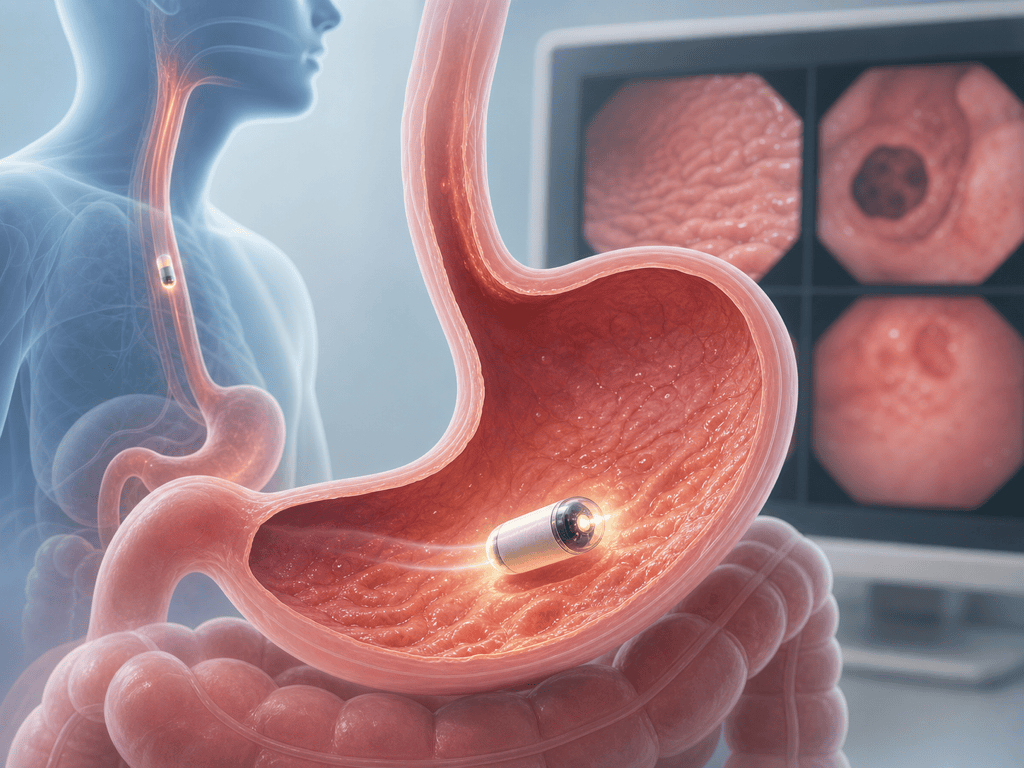
The capsule endoscopy played a crucial role in enabling Mr. P to receive early diagnosis and timely treatment. So, what exactly is this technology that makes gastrointestinal examinations so easy and convenient? The capsule endoscopy is a non-invasive and painless new digestive tract examination technology. Its core component integrates a miniature camera, wireless transmission module, light source, and battery into a device similar to a regular medication capsule. The examinee simply swallows this "smart capsule", just like taking medication. It then "patrols" the digestive tract throughout the entire process, following the natural peristalsis of the stomach and intestines. Simultaneously, it captures high-definition images at high frequency, transmitting them in real-time to an externally worn recorder. After the examination, the doctor analyzes the image data through an imaging workstation to comprehensively understand the condition of the digestive tract mucosa and accurately identify lesions. After the examination, the capsule is naturally excreted with feces within 1-3 days, requiring no retrieval, and the entire process is non-invasive and painless. It is worth noting that the magnetically controlled capsule endoscopy can precisely control the movement and posture of the capsule within the stomach using an external magnetic field, achieving 360° observation without blind spots. Its detection rate for gastric mucosal lesions is highly consistent with that of traditional electronic gastroscopy.
Compared to traditional gastroscopy and colonoscopy, capsule endoscopy offers significant advantages. Firstly, it is non-invasive, painless , and highly comfortable. No intubation or anesthesia is required, completely eliminating the nausea, vomiting, and abdominal pain associated with traditional endoscopy. Secondly, it is safe and reliable . The capsule is for single use, eliminating the risk of cross-infection and posing virtually no harm to the human body. Thirdly, it is convenient and widely applicable . Patients do not need prolonged fasting or special preparation, and the examination does not interfere with normal life and work. It also overcomes the limitations of traditional endoscopy, reaching areas of the small intestine that are difficult to access with traditional endoscopes. Furthermore, it offers precise diagnosis . The new generation of capsule endoscopes has extremely high resolution, clearly capturing even minute lesions. Combined with pathological examination, it can effectively improve the detection rate of early tumors, polyps, and other lesions.
As the most common malignant tumor of the digestive tract, gastric cancer often presents with insidious early symptoms. Approximately 70% of patients are diagnosed at an advanced stage, with a 5-year survival rate of less than 10%. However, early gastric cancer detected through early screening can have a 5-year survival rate of over 90%. Early screening, early diagnosis, and early treatment are key to improving the cure rate of gastric cancer and enhancing patient prognosis. Based on relevant treatment guidelines, experts recommend that different groups undergo regular gastroscopy and colonoscopy examinations according to their individual circumstances: Generally healthy individuals should have their first gastroscopy and colonoscopy screening at age 45-50, followed by screening every 5 years. High-risk groups for gastric cancer, including those with a family history of gastric cancer, a history of Helicobacter pylori infection, chronic atrophic gastritis, gastric ulcers, or those with a long-term high-salt diet, smoking, or heavy alcohol consumption, should shorten the screening interval to, in principle, every 3-5 years.
This case of Mr. P, a patient from Russia, not only demonstrates the efficiency and professionalism of Harbor Health's cross-border medical assistance but also highlights the significant value of capsule endoscopy in the early screening of gastrointestinal tumors.
Note: This international medical case was compiled from patient or family interviews. Important details and images have been protected to preserve privacy and data security.
For more information about medical travel to China or remote consultations with Chinese specialists, please contact Harbor Health.